


Insights
How Is a Working Capital Peg Set in an M&A Transaction?
October 14, 2026
“The business will be delivered with a normalized level of working capital.”
That language appears in plenty of LOIs. It sounds like an easy, agreed-upon term, but until the parties set a number and definition, an important discussion remains. The seller has agreed to leave enough working capital at closing for the business to operate.
But how much is enough?
Key Highlights
Learn How Strategic Positioning Drives Higher Valuations
Start With What Is Included
Before deciding how much working capital is enough, you may need to define what counts as working capital in the deal. Most deals are done on a cash-free, debt-free basis, so cash and debt are typically handled separately from working capital. Operating accounts are usually straightforward, but clarify any unusual items early.
For transaction purposes, net working capital generally means operating current assets, such as receivables, inventory, and prepaid expenses, less operating current liabilities, such as payables and accrued expenses. Deferred revenue may also be included, depending on the negotiated treatment. It is one item worth addressing early in the working capital discussion.
The detailed analysis often takes place a few weeks into due diligence. As part of a Quality of Earnings (QofE) review or a separate working capital analysis, the accountants examine the balance sheet and monthly account balances. They identify potential normalization adjustments, compare working capital across periods, and develop an analysis to help the buyer propose a net working capital peg or target.
Normalizing the Balances
Once you address any account nuances, the next step is to examine the balances within them. A balance appearing on the books does not necessarily represent what the business needs to operate normally. Some adjustments are straightforward; others will require discussion and agreement between the parties. Common examples include:
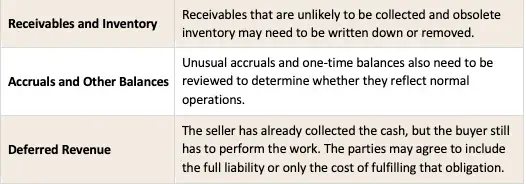
These adjustments deserve the same attention as choosing a historical period. Buyers and sellers may disagree over an item’s value, whether it belongs in working capital, or how to treat it. Working through those points is necessary to give the parties a consistent set of monthly balances from which to assess the target then.
The Average Is Evidence, Not the Answer
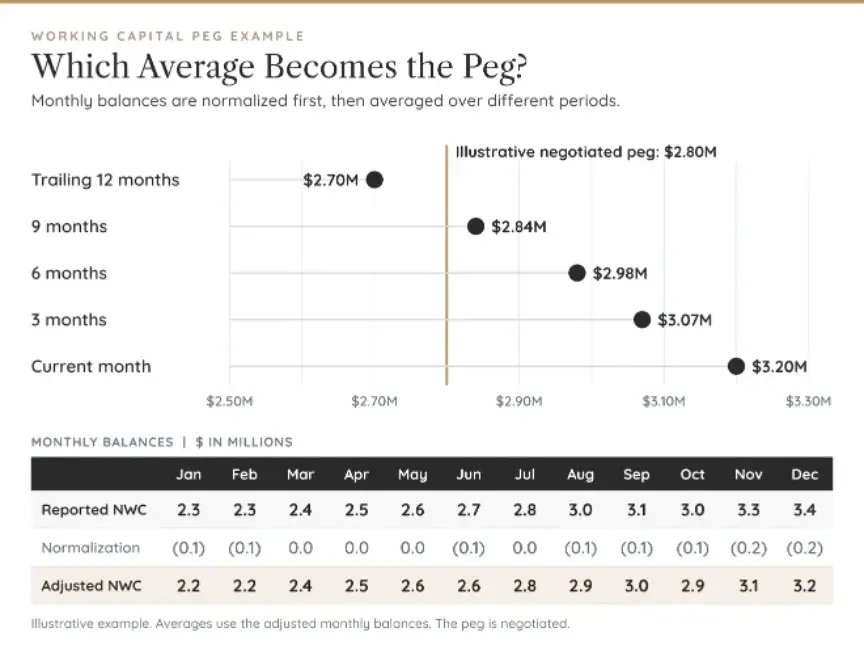
With the monthly balances normalized consistently, we calculate the average working capital level over different periods. In the example below, adjusted working capital averages $2.70 million over 12 months, $2.84 million over nine months, $2.98 million over six months, and $3.07 million over three months. December is $3.20 million. Depending on which period is used, the expected working capital to be provided at closing could differ by as much as $500,000.
Discover How Our Process Maximizes Value and Minimizes Risk
So why are buyers looking at all of these averages?
What Buyers Are Testing
Those averages show how working capital has changed or could change. The next question is which period best reflects what the business will need at closing. A trailing 12-month (TTM) average gives both parties a useful reference point and may well be the most representative measure of the business’ normal working capital needs. Reviewing other periods helps the parties assess whether that TTM average remains appropriate.
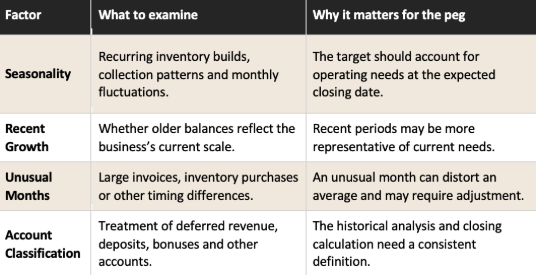
The buyer will compare the periods and consider the following factors before proposing a target:
How the Peg Impacts the Deal
After considering these factors, the parties still need to turn the analysis into an agreed delivery requirement. In this example, they negotiate a $2.80 million peg, above the trailing 12-month average and below the more recent periods. The agreed target reflects their assessment of the business’ operating requirements and the amount the seller agrees to deliver to the buyer on the balance sheet at closing.
At closing, if the seller delivers only $2.70 million of working capital, it creates a $100,000 shortfall against the $2.80 million peg. Under a typical dollar-for-dollar adjustment, that reduces the seller’s proceeds by $100,000. However, if the seller delivers $2.90 million, the $100,000 surplus increases the seller's proceeds by the same amount. These adjustments account for the difference between the agreed-upon amount and what is actually delivered at closing.
Speak With a Benchmark International Expert
When the Buyer Proposes a Number
Because the agreed peg becomes the benchmark for a potential closing adjustment, the seller should understand the buyer’s proposed number and rationale so it can be properly advised. The accounts, normalization adjustments, historical periods, and operating needs should all support the proposal. A few questions can help with that assessment:
The methodology must also carry through to closing. Compare a peg calculated using adjusted balances with closing working capital calculated on the same basis. Otherwise, the parties can agree on the target and still disagree over whether it was delivered.
Remember, no universal formula exists for setting a working capital peg. It is ultimately a negotiated estimate of what the business needs to operate normally. The goal is a target that both sides can support and a seller who understands what must be delivered at closing. Defining the peg, its adjustments, and its basis early gives both parties a better chance to resolve disagreements before they become closing issues that could derail an otherwise solid deal.

Author
Derek Avdul, Managing Partner, Benchmark International
 Share This Post


Explore our curated collection today and stay ahead of the curve in M&A.