


Insights
What is a Cash-Free, Debt-Free Deal?
November 5, 2026
Most LOIs state that the deal will be done “on a cash-free, debt-free basis.” That applies whether the deal is all cash or includes a seller note, earnout, rollover equity, or another structure. But what does that actually mean?
First, here’s what it doesn’t mean. It doesn’t mean you keep all the assets on the balance sheet (e.g., A/R and inventory) AND get paid for the business separately. The balance sheet IS the business, so most of those assets and liabilities are included in the deal.
The purchase price, or headline value of the deal, is typically called Enterprise Value (EV). EV covers the business as it runs day-to-day and includes the receivables, inventory, equipment, and other assets it uses, along with the payables and accrued expenses that come with operating it. Cash and debt, however, are handled separately. Hence, a deal is done “on a cash-free, debt-free basis.”
Key Highlights
Simply put, any debt on the business, other than normal trade payables, is the business owner's responsibility and must be paid off at or before closing. At the same time, the cash on the balance sheet belongs to the business owner, who keeps it at closing. That way, from the buyer’s perspective, the business is delivered free of both cash and debt.
Gain Clarity on Your Next Chapter
When you subtract debt from EV and add cash, you get the company's equity value. That’s the amount due to the seller before fees, working capital adjustments, and other closing adjustments. So, if a business is valued at an EV of $25.0 million on a cash-free, debt-free basis and has $3.0 million of bank debt and $1.2 million of cash, you subtract the debt, add the cash, and equity value comes to $23.2 million.
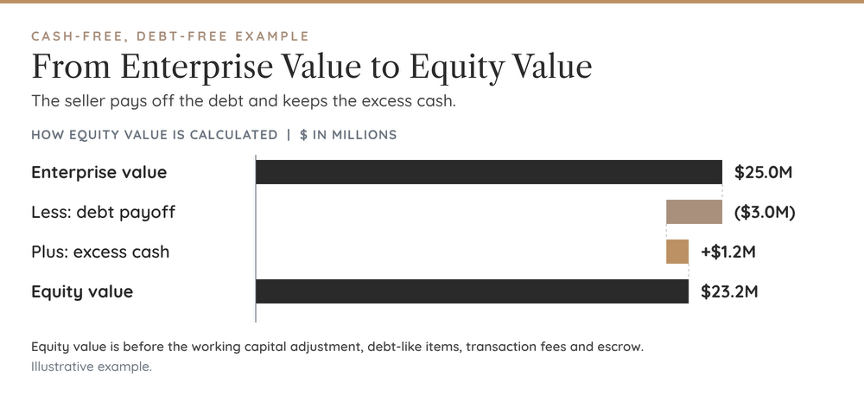
That’s the concept. In practice, a few adjustments can come into play, along with common misperceptions and definitions that can cause confusion. Each can significantly affect what the seller walks away with.
Does a Cash-Free Deal Include Working Capital?
Some owners hear “cash-free” and assume the business gets delivered with nothing in it (i.e., no working capital). That’s not the case. Cash-free means the excess cash comes out.
Receivables, inventory, payables, and accrued expenses stay with the business because the new owner needs them to keep operating. A buyer who acquired a business without its receivables would have to fund payroll and suppliers out of pocket on day one.
That working capital is delivered at a target level, called the peg, that’s set during the deal process. If the business delivers more or less than the peg at closing, the difference is typically adjusted dollar for dollar.
If the peg is $2.8 million and the business only delivers $2.5 million at close, the seller’s proceeds are typically reduced by $300,000. Conversely, if the business delivers $3.0 million, the seller receives an additional $200,000. To learn more about how that working capital target is set, please refer to How Is a Working Capital Peg Set in an M&A Transaction?
What Happens to Cash When You Sell a Business?
But let’s get back to the cash. In a cash-free, debt-free deal, the cash on the balance sheet belongs to the seller. Depending on the deal, the seller either takes it out before closing or it’s added to the proceeds.
One point worth being clear on: in the example above, the $1.2 million cash is already included in the $23.2 million equity value. It isn’t paid on top of it. If the seller takes the cash out before closing instead, the amount paid at closing drops by the same $1.2 million. Either way, the seller gets the cash.
Begin Exploring Your Strategic Options Confidentially
Where it gets less clear is operating cash. Most businesses need some cash on hand to run daily operations. There’s a float between when customers pay and when suppliers and employees need to be paid, and payroll goes out the week after closing, whether customers have paid or not.
So, it’s not unusual for a buyer to ask that a nominal or “normal” level of cash be left in the business. That isn’t a buyer reaching for more money. It’s a buyer asking for a business that can operate on day one, which is what they’re paying for. It comes up more often in smaller deals, where the business tends to run on a thinner cushion.
Not every deal needs it. When one does, it’s often handled as part of the working capital peg. The cash is treated like the receivables and inventory: part of the working capital needed to run the business, and part of what the buyer is paying for in the EV. That means the seller isn’t paid separately for it.
Compared to a purely cash-free deal, if the peg includes $100,000 of operating cash, the seller walks away with $100,000 less. That’s why it’s worth knowing early whether a buyer expects cash to stay in the business, and how much.
For sellers, it’s worth pushing, as part of the broader working capital negotiation, to credit any cash left behind dollar for dollar in the purchase price. That keeps the deal truly cash-free.
What Happens to Business Debt When You Sell?
The debt side is where owners’ assumptions tend to be furthest off. It’s easy to think that if a buyer is acquiring the whole company, the company’s loans come along with it.
When you read about large public company acquisitions, the headlines often describe a buyer paying cash and “assuming the debt.” That’s not how most lower middle-market deals work. Bank debt, lines of credit, and equipment notes are paid off at closing, typically out of the sale proceeds.
That’s true even in a stock deal. In a stock sale, the buyer acquires the legal entity, so technically the debt stays with the company. But the price was set assuming no debt, so the seller still pays it off at closing. The buyer isn’t paying full price and also takes on the seller’s loans.
Work With the World’s Leading Sell-Side M&A Firm
What Counts as Debt?
Since the debt gets paid off at closing, the next question is what counts as debt. Most owners understand that a bank loan does. What can come as a surprise to some is that purchase agreements often include a handful of “debt-like” items as well. These aren’t loans, but they represent amounts the business owes for the period before the sale, such as unpaid bonuses earned before closing, pre-closing taxes, finance leases, and deferred compensation.
Which items are included, and how, is part of the negotiation. Anything treated as debt is handled the same way as a bank loan, out of the seller’s proceeds.
Accrued bonuses are an example. Say a business pays $400,000 in annual bonuses each March for the prior year, and the deal closes at the end of September. By then, roughly $300,000 of this year’s bonuses has been earned but not paid. Because that amount was earned while the seller owned the business, buyers will likely try to treat it as debt and deduct it from the proceeds at closing.
Not every obligation lands there. Customer deposits and deferred revenue, for example, are often handled within working capital, which is generally better for the seller.
Instead of the full balance coming off the proceeds as a debt-like item, only the difference from the normal level is adjusted through the peg. Agreeing on that normal level can take some work, since it depends on how the business collects deposits and when the deal closes. Either way, an item should be counted in one place, not both.
How these items are ultimately handled is usually worked out after the LOI is signed, since it takes detailed analysis and negotiation. But it’s worth identifying them early so they don’t show up as a surprise in the closing numbers.
What Does a Cash-Free, Debt-Free Deal Affect What the Seller Receives?
Coming back to where we started, cash-free, debt-free doesn’t mean asset-free or liability-free. The balance sheet is still the business. Everything it needs to operate goes with it, and the cash and debt get settled at closing.
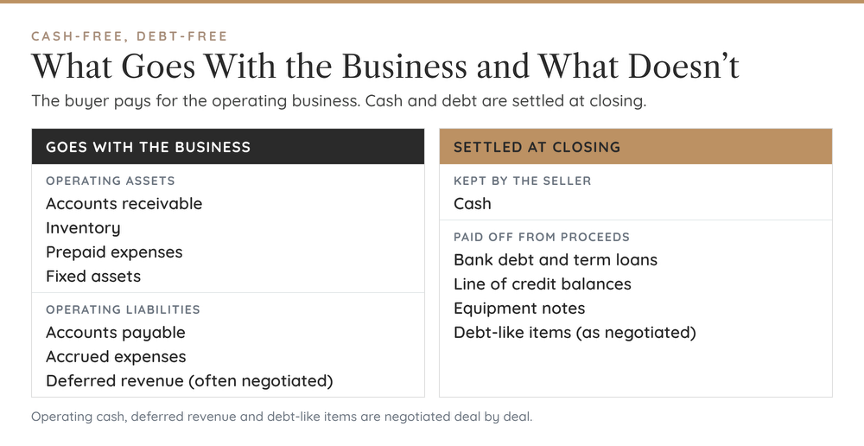
The left side is what the buyer is paying for in the EV. The right side is what turns EV into equity value. The items most likely to vary from one deal to the next are operating cash, customer deposits or deferred revenue, and debt-like items.
That’s why two offers with the same EV won’t necessarily put the same amount in the seller’s pocket. Most of these details aren’t settled in the LOI, but knowing they’re coming, and what’s normal, makes it much easier to understand an offer and avoid surprises at closing.

Author
Derek Avdul, Managing Partner, Benchmark International
 Share This Post


Explore our curated collection today and stay ahead of the curve in M&A.